
Finding the Red Line: Another Resignation Letter from CDC - Voices #24
A public health officer with CDC and USPHS explains why she resigned rather than enforce immigration policies she believes violate fundamental principles of public health and human rights.


We continue our series Voices from the Field: Meeting This Moment in Public Health in which we lift the voices of public health professionals reflecting on the realities we’re facing today - and the lessons learned across the arc of their careers.
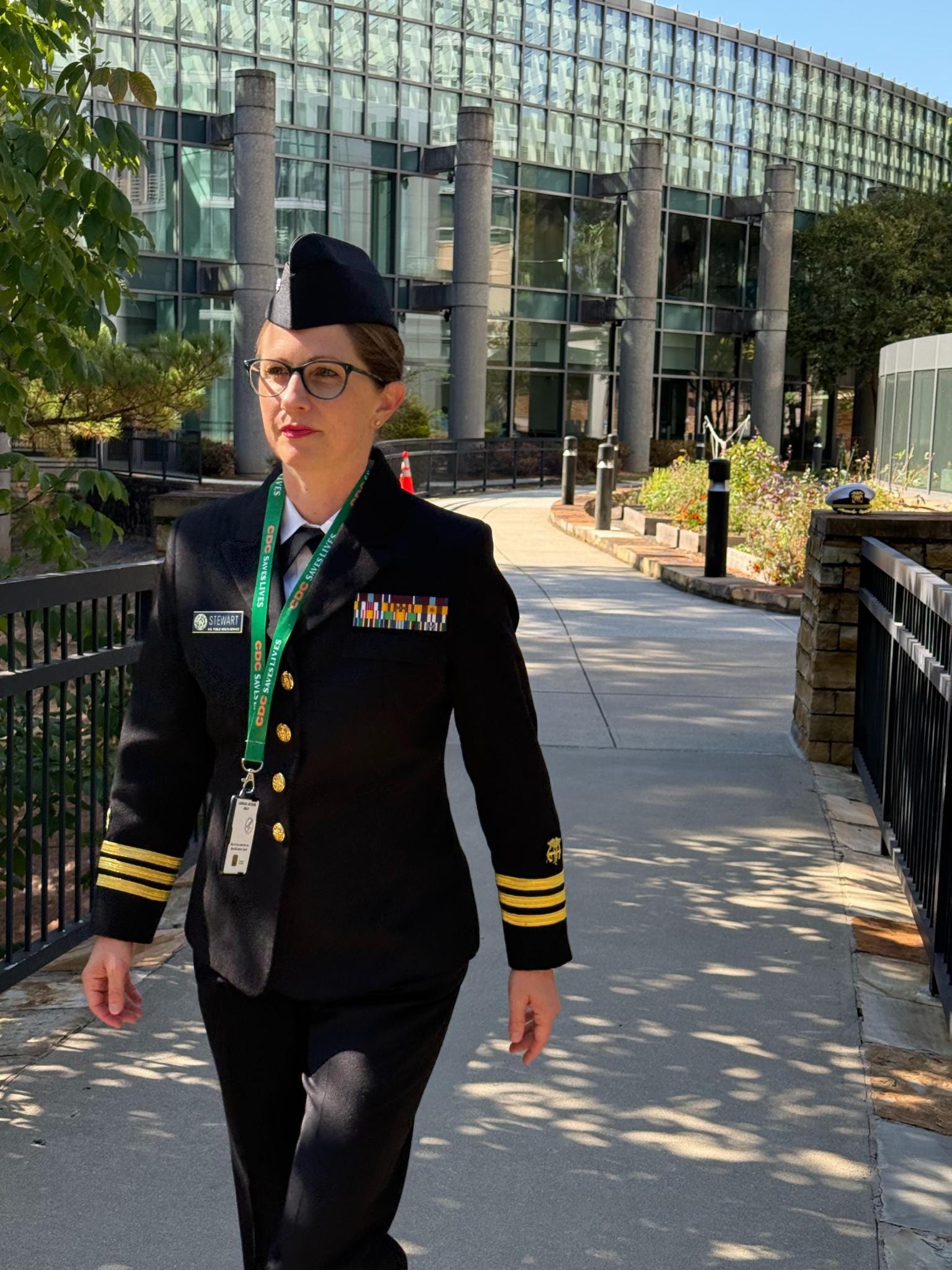
This entry in the series is another resignation letter written in protest and in solidarity. Becky Stewart, a nurse practitioner and commissioned officer in the US Public Health Service and CDC, reflects on the moment when professional duty collided with moral conviction, and why she chose to step away rather than comply.
(We have shared a previous resignation letter here. Is this something we should keep doing? Let me know in the comments.)
If you’d like to follow Becky’s lead and share your own resignation letter or another perspective on public health in these times, I’d love to hear from you. Please get in touch!
Finding the Red Line: Another Resignation Letter from CDC
By Becky Stewart PhD, MPH, FNP-C
Today, on the holiday honoring the birthday of Dr. Martin Luther King Jr., I am thinking about his warning: “History will have to record that the greatest tragedy of this period… was not the strident clamor of the bad people, but the appalling silence of the good people.”
I joined the Commissioned Corps of the United States Public Health Service (USPHS) when I started at CDC in 2015 because I wanted every possible opportunity to serve the public, especially during emergencies such as hurricanes and other natural disasters. I believed in the mission of USPHS and the oath I swore to protect, promote, and advance the health and safety of the nation. I did not anticipate being asked to support a manmade humanitarian crisis that was created by the same government that commissioned me, or to be sent to participate in the forcible confinement of vulnerable people.
I struggled deeply with whether I could uphold my oath and my personal and professional ethics while participating in that mission. In the end, I concluded that I could not. What follows is the letter that I shared with my colleagues on my final day at CDC and USPHS, written in solidarity, grief, and resistance. I share it publicly now on MLK Day as a form of protest against this country’s inhumane treatment of immigrants and to ensure I am not being silent in the face of injustice.
October 25, 2025
Dear Colleagues,
It has been the honor of my lifetime to work alongside you in the fight to eliminate tuberculosis in our country. Together we have investigated and stopped TB outbreaks in food processing facilities, state prisons, and in communities disproportionately impacted by poverty, racism, and inadequate access to healthcare. Together, we have analyzed and published data that bring attention to communities and populations at higher risk for TB and evidence-based interventions to reduce TB-associated morbidity and death. Together, we have centered the work of our TB programs in state, territorial, local, and tribal health departments who we fully recognize as being the engines behind every TB success story in this country. Together, we have managed to keep critical, life-saving TB work in motion while also fighting global pandemics, including Ebola and COVID-19.
It has been a devastating year for our country and for our agency. Together, we have been harassed, discredited, dismantled, and even physically attacked. Together, we have wept, dried our tears, hugged each other, saluted our departing leaders, badged back into work, and continued the fight for public health. And each of us has wondered – what is my red line? When will I have to decide between a job that I love, a mission that I believe in, and an order that I cannot follow?
As a commissioned officer in the USPHS and a nurse practitioner, mine came when I was asked to deploy in support of the mass detention and deportation mission that our government is carrying out. I believe that everyone should be treated as a human, no matter the color of their skin or their immigration status. I believe that families should not be torn apart, communities should not be terrorized, and people accused of crimes should be given due process. I believe that we are a country of immigrants and as such, we should celebrate the incredible contributions of immigrants, documented and otherwise, to our communities, our economy, and our cultural richness as a country.
I cannot be part of a system that is terrorizing our communities and tearing apart immigrant families, even if my role in that system would be as a healthcare provider. I know that my fellow officers who are being deployed in support of this mission are providing the highest quality clinical care to the detained individuals they possibly can, offering compassion and expertise to each person under their care. Regardless of the decision I have made, I have the upmost respect for my fellow officers and gratitude for their dedicated work. However, I am deeply disappointed that my service, the United States Public Health Service, would blindly dedicate officers to this inhumane mission instead of taking a stand against the cruelty and injustice it represents.
Today is my last day with USPHS and CDC. I will continue to use my voice as a private citizen to speak out against these injustices and to speak up for you and the lifesaving work you are doing every day.
In solidarity and love,
Becky
🆕 Action steps
✨Starting this week in honour of MLK Day, all newsletter authors are invited to share action steps to support the public health workforce and the causes we value. We will compile all suggestions into the Resistance Action page that we have been building since we started. ✨
If you would like to use your voice to speak up against how immigrants are being characterized and treated in this country, consider taking the following steps:
Call your representatives and demand humane immigration policies that prioritize family unity and due process.
Resist the cruel and false narratives about immigrants. Tell your families, your friends, your colleagues about the strong, hard-working, and courageous immigrants that you know (including the one that runs this newsletter).
Give financially to or volunteer with organizations that are supporting immigrants.
The views expressed here are those of the author and do not represent the views of any organization, employer, or institution with which they are affiliated.
Becky Stewart, PhD, MPH, FNP-C, is a board-certified family nurse practitioner and public health leader with more than 15 years of experience in infectious disease prevention, including tuberculosis, malaria, and emerging pathogens, and over a decade of federal service. Her work has focused on coordinating multidisciplinary teams, delivering evidence-based care in underserved communities, and leading national surveillance and outbreak response efforts. She completed postdoctoral training in applied epidemiology at the U.S. Centers for Disease Control and Prevention through the Epidemic Intelligence Service program. She is hoping to find work that will allow her to fight for immigrants’ rights to healthcare and safety more effectively outside of federal service.
If you would like to share your perspective on public health right now in this Newsletter written TO and FOR and BY and ABOUT the public health workforce, we are currently running two series:
Write an opinion article grounded in lived experience for Voices from the Field: Meeting This Moment in Public Health; or
Compose a Love Letter to Public Health in poetry, prose, visual art, or another creative medium.
✨🆕 I’m also considering a new series: Resignation Letters. With this entry, we have now shared two letters from public health professionals who felt compelled to leave, and their words make clear how much is being lost in this moment. If you have left the public health workforce during this period, for any reason, and want to share your reasons or your message publicly, I invite you to get in touch. This platform exists to document what is happening to our people and our institutions while the record is still being written.✨
Please get in touch if you would like to submit a draft to any of these series. I will work closely with you to prepare it for publication. Review previous instalments for examples. I will offer you my personal promise of confidentiality if requested.
✨🆕Resistance action steps - Editor’s note from Katie✨
Thank you for reading this newsletter TO and FOR and ABOUT and BY the public health workforce. At this tumultuous time, I’m still really not sure where we go from here. But each time that I publish this newsletter and receive positive feedback from readers, my list of ideas for action steps continues to grow. I will start to compile these suggestions here. As we learn more, let’s keep adding to this list.
I close by emphasising the action steps I suggested in a previous newsletter:
“At this time of uncertainty for the public health workforce, let’s remember our commitment to science and evidence and data. We know that validating emotions and baggage has a place too, but we need to be able to identify them and distinguish opinion from fact.
Let’s recommit to kindness and mutual support for the public health workforce and beyond. If leaders are trying to sow divisions among us, the best we can do is to respond with empathy, and by strengthening, connecting, and lifting up one another.
Right now, the best I can offer my fellow public health professionals is a place* to gather and reflect and share and vent and organize and ask questions and offer support to one another. We’re going to need that now more than ever.”
*This is a plug for the Public Health Connections Lounge on LinkedIn, where we seek to build community and conversation among public health professionals. Join us.
If you are new around here, Welcome to The Public Health Workforce is Not OK! In this newsletter, I share frank insights and start conversations about the experiences of building a public health career. You can get to know me here and here. Please subscribe, review the action steps and the archive, and join the conversations in the Lounge. I am committed to keeping this newsletter free for job seekers (at least, for as long as I still have a job).
 | A guest post by
|
Powerful articulation of where professional ethics and institutional demands diverge. The framing of finding one's red line captures something critical about moral decision-making in bureaucracies, most people dunno where that line sits until they're forced to cross it. The tension between providing quality care within a harmful system versus refusing participation entirely is real, I've seen similar dilemmas in healthcare settings where the structure itself becomes coercive even while individual practitioners mean well.
Yes please, keep sharing