
The Things We Should Not Need: Navigating Career and Cancer From Within a Fractured System - Voices #28
A former CDC epidemiologist exposes the human cost of brittle public systems and shows what is lost when risk is transferred from institutions to individuals.

We continue our series Voices from the Field: Meeting This Moment in Public Health in which we lift the voices of public health professionals reflecting on the realities we’re facing today - and the lessons learned across the arc of their careers.
Former CDC epidemiologist Lindsay Norris offers a firsthand account of what happens when systems fail and individuals are left to absorb the damage. As she traces her journey, she reveals how survival hinges on insurance, luck, and personal sacrifice.
If you’d like to follow Lindsay’s lead and share your own perspective on public health in these times, I’d love to hear from you. Please get in touch!
The Things We Should Not Need: Navigating Career and Cancer From Within a Fractured System
By Lindsay Norris, MS
I grew up in the rural heartland of the United States where most people ran family farms or ranches. Many had no health insurance. Some did not trust doctors at all. When a family was affected by a catastrophic accident or illness, the community responded the only way it could: benefit auctions, shared meals, and showing up with whatever they had, even when their closest neighbors lived far apart. There were very few people with full time jobs and benefits, yet generosity was constant and expected.
I remember once when a neighbor pulled into our church parking lot with a pickup truck full of free food distributions from government surplus. Every family received a box: no forms to fill out, no questions asked. I later learned that our area was considered impoverished, which I found confusing. I recall that when Aerosmith told us to “Eat The Rich” in 1993, nobody in particular came to mind. I didn’t yet realize that meant that our area was considered poor.
I went to college and met rich people. They wore fashionable clothes, ate things like fried rice and gelato, and went to the doctor even when they were not sick. They did not worry about money for books or gas. I borrowed so much money for college tuition that it made me feel physically nauseous.
Choosing Public Health Over Complicity
I wanted to become a doctor so I took pre-medicine requirements like organic chemistry and microbiology. I learned anatomy, calculus, and physics. But as I followed my studies, I watched clinical decisions being made around insurance coverage, sometimes leaving patients with enormous medical bills, sometimes denying care outright. I soon realized that I did not want to become part of a medical system that treated access as optional.
So instead, I chose to go to graduate school to study public health. I earned a degree in epidemiology and began studying chronic and infectious diseases. I was still haunted by the plight of the uninsured. Over and over, I noticed the same pattern reappear. I never found a health condition that was not correlated with health insurance status. I became weary of presenting data that showed, yet again, that lack of health insurance was one of the strongest predictors of poor health outcomes.
Eventually, I was hired as an epidemiologist at the Centers for Disease Control and Prevention. I suppose I became one of those rich people. By most measures, I had crossed an invisible line: I took my kids to the pediatrician when they weren’t sick. They had their wisdom teeth pulled. I bought them sushi and Converse shoes. I stayed in my job long enough to have my student loans forgiven as a reward for public service. It felt rewarding to use my expertise to improve health at a population level. For the first time, stability felt real.
When Stability is Revocable
Although federal service was meaningful, it was not always pleasant and it was rarely easy. With every change in political administration, managers spent more time defending the existence of programs, and less time delivering them. Directives from above were disruptive, but we worked hard to keep our programs aligned with congressional mandates and public need.
After twenty years of working in public health, my stability vanished overnight when I was fired in the Reduction In Force (RIF) of April 1, 2025. When the incoming Secretary for Health and Human Services, Robert F. Kennedy, Jr., told Congress that no scientists had been fired in these RIFs, I wondered what that made me and my entire team. I listened as people debated how serious the chaos really was, while friends outside work told me, sincerely, “I thought you were all reinstated.”
I looked for work that matched my analytic skills, but the job hunting process was demoralizing. There were plentiful jobs to apply for, so I spent countless hours filling out online forms, yet I rarely received a request for an interview. When I finally got an interview, it was a one-way video interview where I recorded my answers alone on camera, with nobody else present or appearing to care. Sometimes I received a pro forma email within minutes of applying, saying that the employer had already moved forward with another candidate. I struggled to find a new way to use my skills and experience.
When Systems Fail, Bodies Absorb the Cost
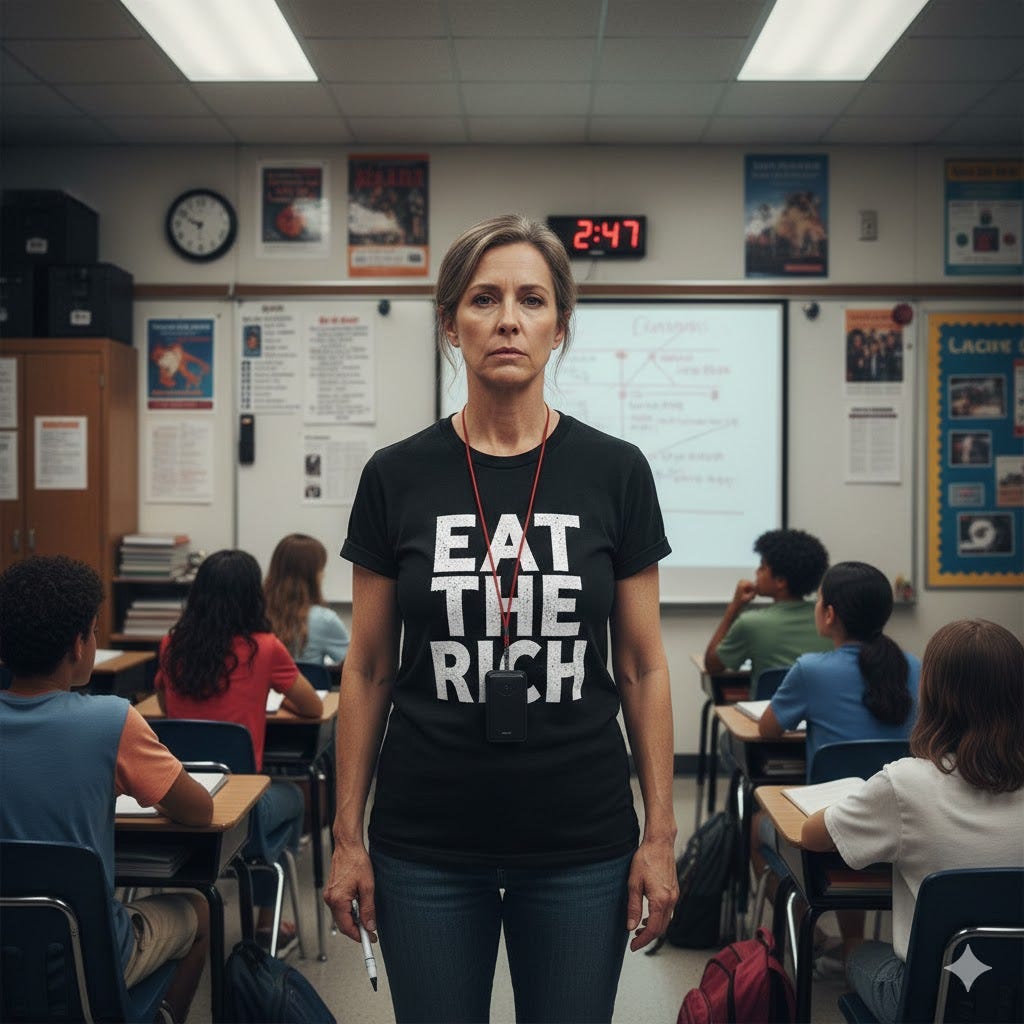
Eventually, I traded my federal ID for a teacher ID, and was hired as part of an effort to bring experienced professionals with real-world expertise into science, technology, engineering, and math classrooms. I received training on school protocols, such as when to refer a student to a counselor. At the school where I landed my first teacher training position, every teacher wore a panic button around their neck, ready to lock down the building at a moment’s notice due to the risks of violence. I had entered another system claiming to protect children while routinely exposing them to harm, where underfunded classrooms, untreated mental health needs, overcrowding, and the constant threat of violence are managed through drills and devices rather than prevention, care, or stability. The burden of absorbing risk is assigned to children and the adults nearest to them, not to the lawmakers or institutions with the power to reduce it.
On the first day of school, I wasn’t even in the classroom - I was at the hospital receiving a diagnosis of colon cancer. While I had accrued over 400 hours of sick leave in my CDC job, my new position offered me no options for sick leave. I knew that if I lost my job, my children and I would lose our health insurance, so I reduced my chemotherapy and kept working. Once again, coverage dictated care.
I decided not to ask for help from my friends or family, many of whom were barely meeting their own needs. I asked corporations for help instead. My mortgage company offered support. The hospital did not.
I often hear that we should not need to spend billions of dollars on public services. It is increasingly clear from where I stand that if public services were managed well, many downstream costs would disappear. People would not work while sick. Cancer patients would not have to alter their treatment schedule to keep their jobs. Teachers would not need to wear panic buttons. Charity would not be a substitute for systems.
Americans should not need wealth to be healthy. We deserve public services that are fair, effective, and humane. Randomly firing public servants does not make government efficient: it makes it brittle. And when those systems fail, the cost is paid in bodies, in families, and in lives that did everything that they were told was right.
🆕 Action steps
✨Starting in honour of MLK Day, all newsletter authors are invited to share action steps. We compile all suggestions into the Resistance Action page that we have been building since we started. ✨
If you would like to support the public health workforce, consider taking the following steps:
Share a note of thanks to the many public health heroes across the nation
Support former CDC colleagues through the CDC Mutual Aid Network
Stay informed with resources for former and current federal workers from the Partnership for Public Service
Nurture the future of public health by being a part of the APHA Mentor Match as mentor or mentee
The views expressed here are those of the author and do not represent the views of any organization, employer, or institution with which they are affiliated.
“Lindsay Norris” MS is a pseudonym for an epidemiologist who began her public health career at a local health department in 2005. She served as a federal government contractor for five years at the Substance Abuse and Mental Health Services Administration. She has worked at the Centers for Disease Control and Prevention for twelve years, including contract and full time roles.
If you would like to share your perspective on public health right now in this Newsletter written TO and FOR and BY and ABOUT the public health workforce, we are currently running two series:
Write an opinion article grounded in lived experience for Voices from the Field: Meeting This Moment in Public Health; or
Compose a Love Letter to Public Health in poetry, prose, visual art, or another creative medium.
🆕 I’m also considering a new series: Resignation Letters. We have already shared two letters from public health professionals who felt compelled to leave, and their words make clear how much is being lost in this moment. If you have left the public health workforce during this period, for any reason, and want to share your reasons or your message publicly, I invite you to get in touch. This platform exists to document what is happening to our people and our institutions while the record is still being written.✨
Please get in touch if you would like to submit a draft to any of these series. I will work closely with you to prepare it for publication. Review previous instalments for examples. I will offer you my personal promise of confidentiality if requested.
I close by emphasising what I said in a previous newsletter:
“At this time of uncertainty for the public health workforce, let’s remember our commitment to science and evidence and data. We know that validating emotions and baggage has a place too, but we need to be able to identify them and distinguish opinion from fact.
Let’s recommit to kindness and mutual support for the public health workforce and beyond. If leaders are trying to sow divisions among us, the best we can do is to respond with empathy, and by strengthening, connecting, and lifting up one another.
Right now, the best I can offer my fellow public health professionals is a place* to gather and reflect and share and vent and organize and ask questions and offer support to one another. We’re going to need that now more than ever.”
*This is a plug for the Public Health Connections Lounge on LinkedIn, where we seek to build community and conversation among public health professionals. Join us.
If you are new around here, Welcome to The Public Health Workforce is Not OK! In this newsletter, I share frank insights and start conversations about the experiences of building a public health career. You can get to know me here and here. Please subscribe, review the action steps and the archive, and join the conversations in the Lounge. I am committed to keeping this newsletter free for job seekers (at least, for as long as I still have a job).
Amazing, beautifully written, and an inspirational call to arms!
Thank you all for your service. Epidemiologist here, and I see you. This piece is so moving and such a gut-punch. I hope “Lindsay” is healing. I hope our system heals, too.